
Hiker, Fisher, Dishwasher, Host
Gifted by Doug Gouge
Gathered by Nancy Small
Dayton, March 2026
Although Doug moved to Wyoming later in life, he had been establishing deep connections to its people, rivers, and wild places for many decades. Here, Doug shares two stories: one of coming to Wyoming and another of creating experiences where visitors can also appreciate the state. These reflections have him thinking about what it means to finally be home.
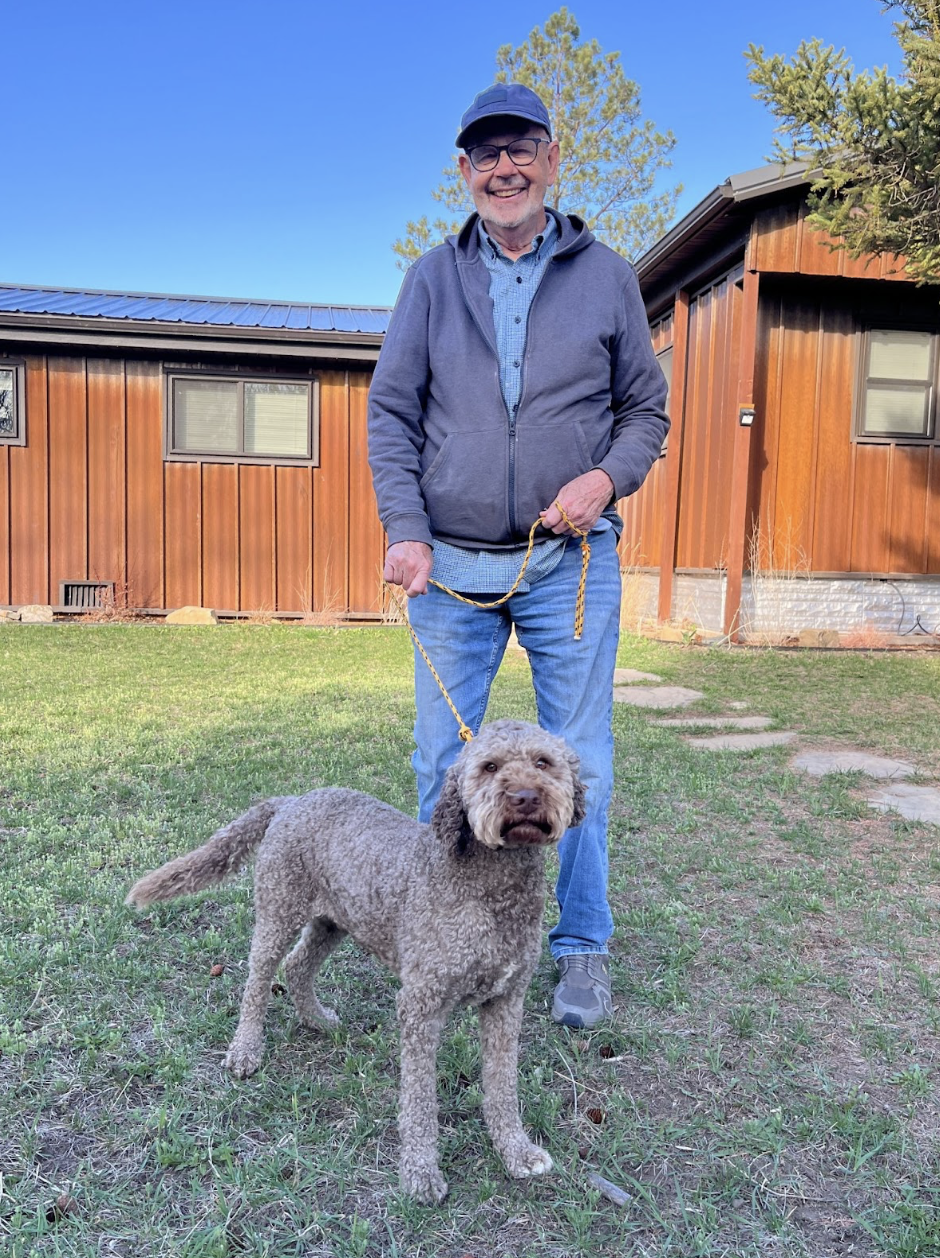
Doug and his beloved Wiley. Photo by Nancy Small.
Doug:This is a two-part story. One is, how did I end up in Wyoming from Pittsburgh, and the other is, how did I end up owning a fishing lodge when I'm 80 years old.
So, how I ended up in Wyoming is…I was enamored with the idea of backpacking and fly fishing. And I answered an ad in Backpacker Magazine, a little 1-inch ad, and I flew out to Wyoming, and I met with an outfitter named George Hunker. We backpacked into the Wind River Mountains, and it was the beginning of a love affair with Wyoming. I came out and backpacked with George for 20 years, and I loved it. And I always wanted to be in Wyoming, but my business, my family was all in Pittsburgh, and I couldn't figure out how to get here.
So then at some point, George said, “Why don't you come fishing with me? I'd like to show you the Bighorn River.” He took me to Fort Smith and the Bighorn River, and I fell in love all over again. I remember going to Three Mile take out point or put in point, and I saw big fish scatter as I walked to get into the drift boat. I thought, “This is it. I've come home.”
So I continued going to the Bighorn every year for a number of years. Then I sold my business about 2010, and I found myself unattached to anything, and I thought, “Welp, I should go to Wyoming.” And I talked to the owner of the lodge and said, “Hey, how about if I come out and cook, work in the kitchen?” They said, “Absolutely not. You just want to come out here and fish.” And I said, “No, no. I understand. I understand work.” And so the owner, her name was Carrie, she relented, and I came out and worked two seasons at the Big Horn, at the Kingfish Lodge. I thought I was going to be a cook, but as it turned out, I was a dishwasher. But I was pretty good at it! And I bought an old trailer to live in.
I told Carrie that I really want to find a place to live or to be here more permanently, but not in Fort Smith. And she said, “Well, we live in Dayton, Wyoming. Why don't you stay in our house in Dayton and look for a place?” And I thought, “That's great.” So I did. Later, it turned out they were moving, and she said, “Do you want to buy our house?” And I said yes. And so I bought their house. They're awesome, and that's how I ended up in Dayton.
Then I continued to fish at the Kingfisher Lodge. The owners changed a couple of times, and
things kind of went downhill, and so I said to the owners, “You know what? You oughta sell this place to me, because you don't know what you're doing.” (chuckle.) And they said, “Oh, no, we're in it for the long haul.” And I said, “Okay, fine” and forgot all about it.
Well…you know, two years later, they called me up and said, “We want out.” And I said, “Oh, really? I was just kind of kidding…” I talked to my good friend Emerson Scott, and I said, “Hey, you know, we can buy the Kingfisher,” and he said, “Well, okay, let's do it.” He’s been a great friend to me. He’s always a “yes,” you know? When I say, “Let's do this or let's do that!”
So we didn't think they would accept our offer. They did, and then all of a sudden, I ended up being a 50-50 partner with Emerson Scott, owning the Kingfisher. And so I went from, as I say, my story, that I went from being a dishwasher to owning it. Yeah. That's my new adventure, so it's pretty exciting, and uh… that's my story.
Nancy: What’s something about your 50-50 ownership in the lodge that brings you joy, and what's something that's hard? Or what's something challenging that surprised you?
Doug:Sure. I was in the oil and gas business, and I never dealt with the public. We never physical…we didn’t own anything. We developed prospects. Well, with the Kingfisher Lodge, all of a sudden, we had a big material we plant with electrical problems and plumbing problems, and OSHA problems…and I had not anticipated those kinds of things. Emerson had run Antelope Butte, a little ski lodge in the area, and was very familiar with those things. He's also an engineer, so it was great that we were partners, because he understood that side of things that I really didn't understand. So I'd say that's been the most difficult part for me.
I'd say that the most joy is being a part of…creating that…Bighorn River experience for guests from all over the country. I really enjoy meeting with them, talking to them, and listening to their expectations for the day. Then they come in after a day of fishing and are talking about how many fish they caught and how big they were,and how interesting the guide was, and they saw a Kingfisher, and they saw this, they saw that. So I really enjoyed that part.
Nancy:It almost sounds like, not just going from dishwasher to owner, but also you’ve come full circle. Being someone who wasn't from Wyoming, but fell in love with it, is now helping other people come here and find their Wyoming story, too, yeah?
Doug: Yeah. That's great. I think…yes, absolutely. I think for me, personally, I found that I feel like I’m at home in Wyoming. You know, “home” is sort of an interesting concept, you know? What is home? Most people have a vision of what that is. And I never felt at home in Pittsburgh, even though I lived there for 25 years, but that wasn't quite it.
Where I grew up, my mother always said, “This isn't it. This little town isn't it. There's a big world out there.” And so, “home” was elusive for me. I find that being in Dayton and being in Fort Smith, and being in Wyoming feels like home to me.
Note: The transcript above has been condensed from its original audio recording to improve the flow and readability of the story.