
Peace Corps Stories and Lessons
Gifted by Sheila Newlin
Gathered by Lena Newlin
Riverton, November 2025
Sheila Newlin discusses fulfilling her lifelong dream of joining the Peace Corps. She and her husband, Doug, served in Papua New Guinea in 2000 after their three children were out of the house. Sheila shares stories of learning how to use a machete, receiving precious gifts, and the important lessons she learned about life while living abroad.
This story was gathered as part of a graduate course in fall 2025.
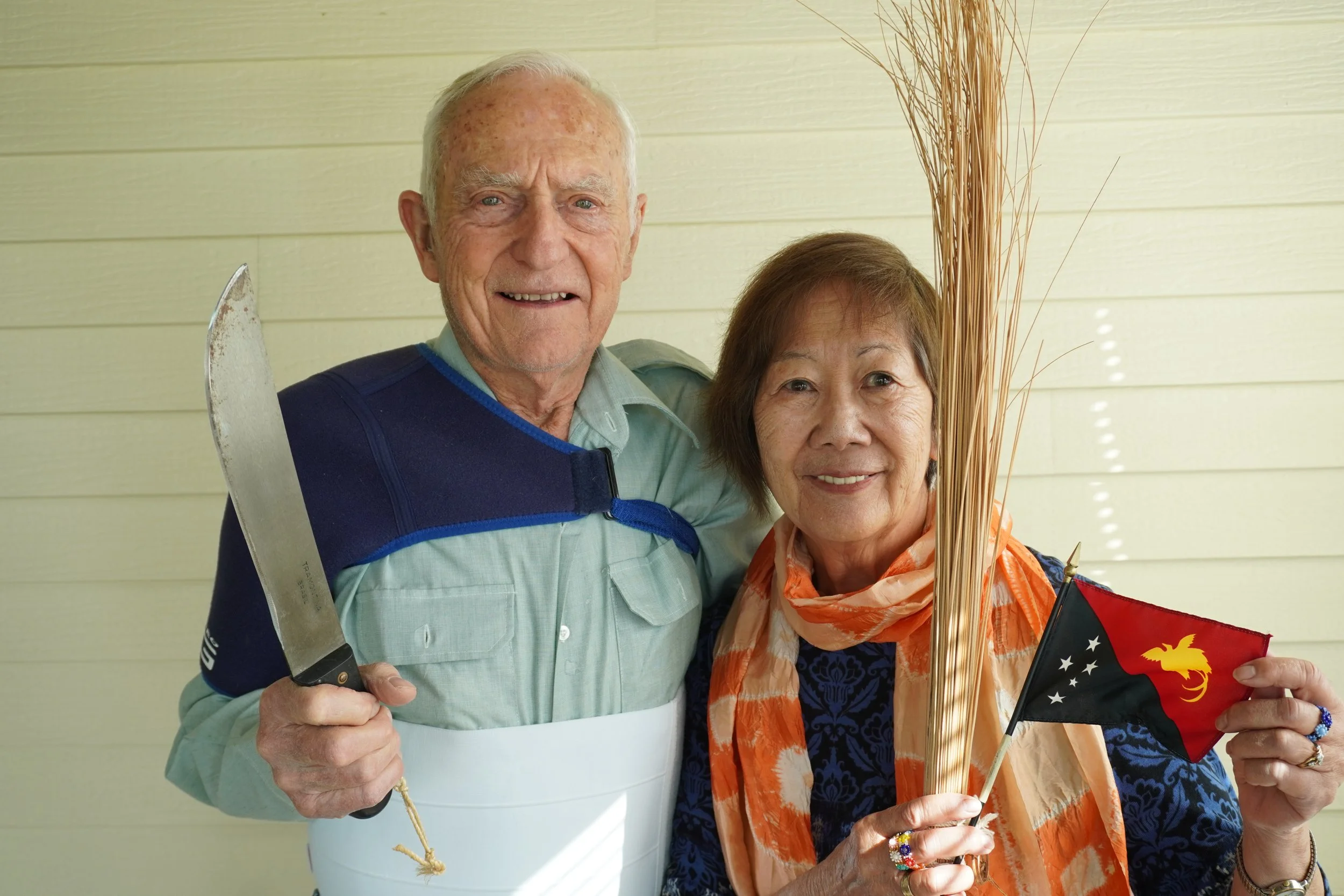
Doug and Sheila Newlin demonstrate a machete, a broom, and a Papua New Guinea flag that they brought back from their service in the Peace Corps. Photo by Lena Newlin.
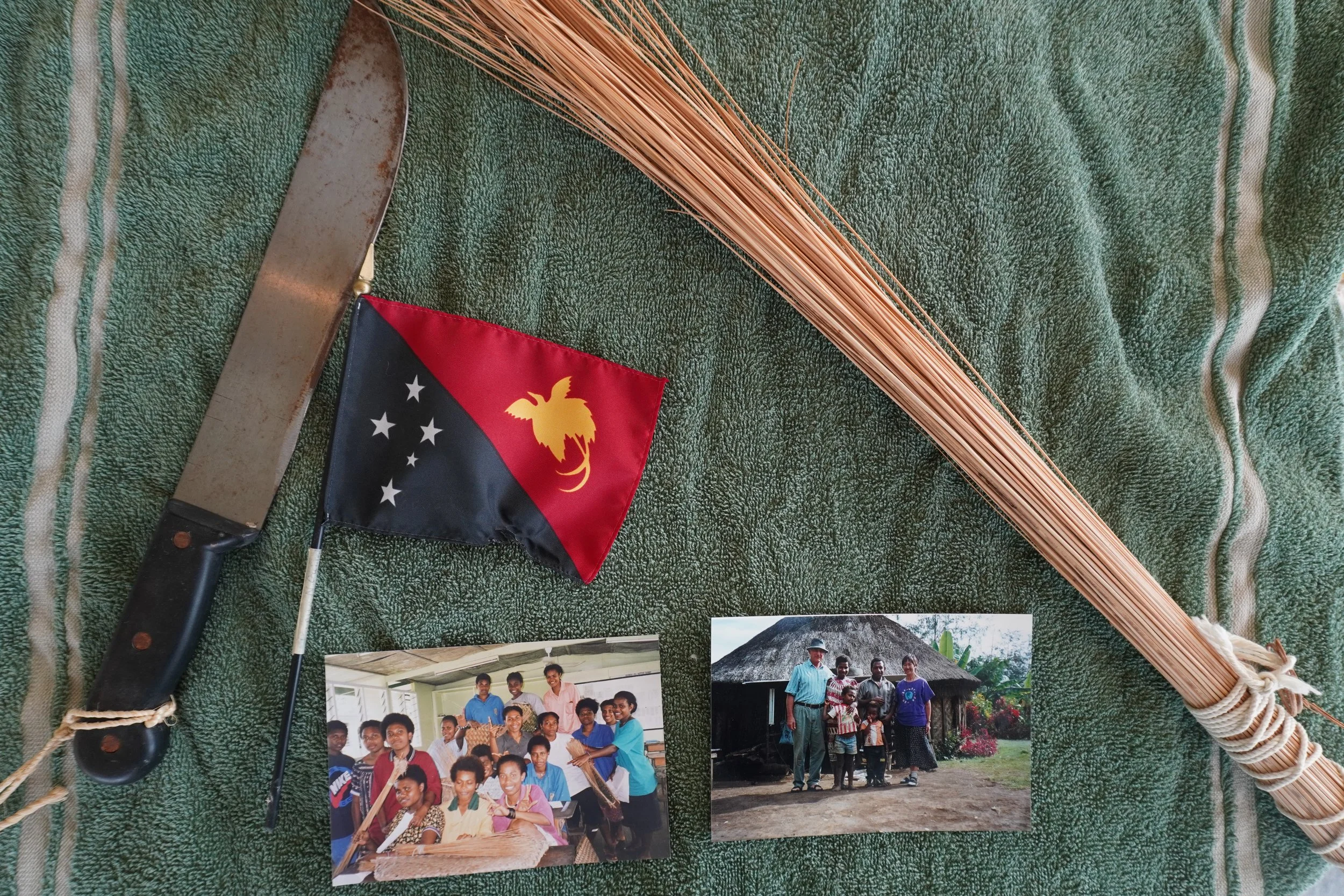
Photographs, a machete, a broom, and a Papua New Guinea flag are mementos from Doug and Sheila Newlin’s time in the Peace Corps. Photo by Lena Newlin.
Sheila: Peace Corps was an outstanding moment of my life. I had wanted to join Peace Corps even before I came to Wyoming. I wanted to join Peace Corps ever since our president, John Kennedy, started Peace Corps in 1961. I was in about seventh or eighth grade at that time, and I knew that that was something I wanted to do.
However, it was not until 30 or 40 years later when I actually joined, after we lived in Riverton. Doug had been in the Peace Corps in El Salvador from 1965 to 1967. When I met him in college, he had just returned from El Salvador. He gave a talk about Peace Corps. And again, I had the desire to go to Peace Corps.
Well, a couple of years later, we became engaged and he wanted to marry me and I said, “I will marry you under one condition. Will you take me into the Peace Corps?” He said, “okay,” because he really wanted to marry me and I really, still wanted to fulfill my goal of Peace Corps.
So he said, “Sure. Okay.” Well, I was a teacher and we moved to Wyoming where we both were able to work. He owned his own plumbing business and I taught at Riverton High School. Okay. Then, um, [we] started having children. Well, we can't go into Peace Corps now 'cause we've got a kid in kindergarten; we've got a kid in third grade; we’ve got a kid in fifth grade. So it's gonna have to wait. So at that time we said, well, we can’t go to Peace Corps now. We had to wait, and this is true of other Peace Corps volunteers. You have to have a certain window of time. You have to consider your parents. You have to consider your brothers and sisters, your jobs, as well as your children and your home.
So we just said, okay, well let's wait till our youngest goes to college. And we knew everybody would be fine right there at UW. That's a very wonderful university and a wonderful town. So we thought, okay, our kids are gonna be fine. Our parents are fine. Brothers and sisters are fine. So now is our time to go.
And so we went in the year 2000. We did not know where we would be placed. You do not get a choice. I had put my first choice as a Spanish speaking country because my husband and I had both studied Spanish and he had had experience in El Salvador in the Peace Corps in 1965, and I had studied some Spanish. So our hope was to be in a Spanish speaking country in Central America or South America.
My second choice was Africa. The third choice was just blank. I said I will go anywhere, but I do not want to go where it's hot because I'm used to Wyoming winters and I do not want to go where there's water because I can't swim. Well, as you can tell, our choices were not even looked at. We were sent to a small island called Papua New Guinea, which is north of Australia, about four degrees south of the equator–very hot. And Doug and I were sent to a secondary school, which was grades nine through 12, and he taught industrial arts and business studies, and I taught English--junior English--which is what I had been trained for many years earlier when my major was English education.
Lena: So you have a few things here on the table. Tell me about a couple of the items that you have on the table that you brought back.
Sheila: Well, one thing that's very surprising in our training, we had to have, we had to learn about the language and the culture. And one thing we needed to all learn was how to use a machete. Now, would you ever imagine that in Peace Corps [you have] to learn how to use a machete?
The women had small machetes about 20 inches long, and the men had longer machetes. And so we were taught how to stoop down on our knees and cut the grass with our machetes. Now, when I went to our site at Malabunga Secondary School, then I could see why machetes were important. However, at our site, the girls used brooms and the boys used machetes.
In the Papua New Guinea culture, there are very strong gender requirements and gender traditions–a dividing line between what the men do and what the women do at the secondary school. Every day after class, the boys would bring out their machetes and they would cut the grass. The girls would use their brooms and they would sweep up the weeds and the grass so that every day the lawns were beautifully manicured and trimmed.
The men--the boys--these are high school boys. They would get scolded if they did not bring their machetes to school. And I remember one time I was sitting in on a meeting and the male teacher was scolding the boys. He would say, “some of you boys are not bringing your machetes to school and you're gonna be in bad trouble if you don't bring your machetes.”
Now, can you imagine that happening anywhere in the United States? Here you would be, your parents would be called and you would probably be sent home if you had something as small as a three-inch pocket knife. And the girls were required to bring their brooms. Every girl had their own handmade broom, which they made out of palm leaves or just the brush.
So those were some of the jobs of the boys and the girls. So I really like the fact that I could bring my own machete home with me.
Lena: Do you have other lessons that you learned?
Sheila: I learned the importance of family and caring about one another as a community and caring for strangers too.
Not just caring for your own family and their neighbors and the people, but people were so good to us. They did really have an emphasis on family. My husband, Doug, and I, we came here leaving our three children and they could not understand how we could leave our children, even though they were in college. “Why did you leave your children?” It was almost a catastrophe that anyone would even think about going to another country. But once they got to know us, then we became family with them.
So the stories revolve mostly around the kindness of the people, the kindness of neighbors, strangers, and food was very important to everybody sharing meals. And there were big meals when we left; there were big meals where everybody had potlucks and they celebrated, as they tearfully said their goodbyes to us. Saying goodbye was very difficult for me.
Lena: Tell me about one of your students.
Sheila: I had such wonderful students. I really loved my students. The hard thing was when we left, it was really hard to say goodbye, and they kept wanting to give me gifts. And there was one student of mine, he was a junior. He came up to me and he apologized. He said, “Mrs. Newlin, I'm so sorry. I don't have anything to give you, but I will give you this shirt.” So he took off his sweaty shirt that said Malabunga High School. He took it off of his back and he handed it to me as a gift. He gave me the shirt off of his back.
Lena: Is there anything else you want to share about being in the Peace Corps?
Sheila: I would encourage other people to just be aware of opportunities and grab them when they come up. You will never regret any kind of decision you make when it comes to travel. Any time you travel, you learn--whether it's right here in Wyoming or whether it's to the south or to the north or around the world. I encourage people to travel and to give to others because as you know, the more we give, the more we receive.
Note: The transcript above has been condensed from its original audio recording to improve the flow and readability of the story.