
Sobering Up to Help Others
Gifted by Judy Johnson
Gathered by Lena Newlin
Laramie, November 2025
Judy Johnson’s whole life has been involved with alcohol. She recounts her long journey to sobriety and eventually becoming a licensed substance abuse and mental health counselor.
Note: this story includes references to drug and alcohol use and suicide.
This story was gathered as part of a graduate course in fall 2025.
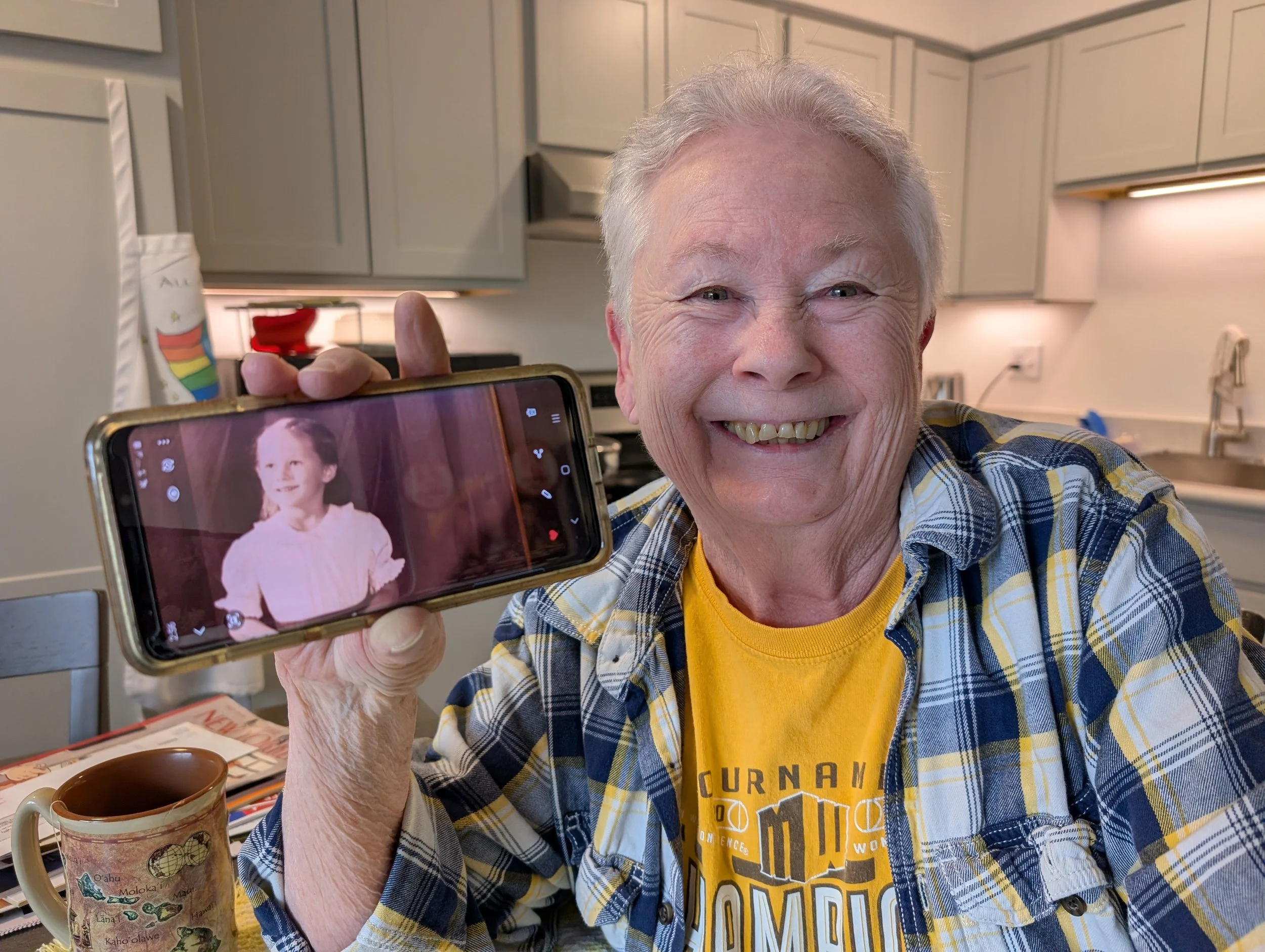
Judy Johnson has reclaimed the 7-year-old girl that she was in the photo through becoming sober and helping others as a licensed substance abuse and mental health counselor. Photo by Lena Newlin.
Judy: My whole life has been in some way involved with alcohol. My father was in the pulp and paper mill industry, and before he left for the service, he was a chemist. When he came back, he decided to sell pulp and paper mill machinery, which meant we ended up moving frequently.
Back in the ‘50s, wives stayed at home, so my mom didn't work. She was a stay-at-home mom. And my father and she drank quite a bit. They would have their parties, their cocktail parties and all that kind of stuff, and when I was six, seven years old, I'd actually serve drinks at their cocktail parties. Matter of fact, I loved the maraschino cherries in the Manhattans. I was probably 40 years old before I found out that maraschino cherries didn't taste like whiskey. I always liked those maraschino cherries because they gave you such a good feeling in your chest as they were going down. So that's my first experience with alcohol. Of course, everybody smoked then. And they even, you know, smoked on airplanes and they gave us little wings that we could wear and they also gave us a pack of candy cigarettes. So of course I ended up being a smoker and a drinker.
With dad gone, mom was drinking. There were times that after a week or so of her drinking and not really functioning, I'd call my dad and he might be in Three Rivers, Canada, or he might be in British Columbia; he might be anywhere. He might be in Washington State. But he always left me an itinerary, or mom the itinerary. I could always reach him. So I would call him up and say, “Dad, she's really bad. She's been bad for a week.” And I'm eight or nine years old, right? And “can I throw out the alcohol?” Of course, I didn't know that that wasn't gonna help, but my dad said, “go ahead, yeah.”
Now, obviously my dad could have maybe done something about all this, but he liked to drink too. He liked his cocktails at night after work. So he didn't really do anything, but he knew mom was having a problem. But back in the ‘50s, they just patted women on the head and gave them drugs. And so next thing I know, my mom's doing the drinking and the drugs. So I was already learning to be by myself all the time.
I can remember one time when we were driving across the country, we broke down in Ten Sleep, Wyoming. I was asleep in the car when they broke down. And the motels in Ten Sleep, right? Not very many. So they called a rancher and asked him if we could stay with them. And the rancher took us in that night. Of course, [they] carried me in to the bed. I woke up the next morning and I heard weird noises, man. And all these weird noises were coming out the window. And I went to the window and looked and there was chickens and there was horses and there was cattle. And I was just thrilled. And so Wyoming was my place, and I never forgot Wyoming.
In eighth grade, I found these guys that were drinkers and hung around with them and I was already drinking. I still got good grades, so nobody could say anything about what I was doing. And mom and dad would be gone. And now dad was vice president and general manager of the division…and anyway, his drinking kept getting a little bit more worse, a little bit more worse, and then it just wasn't cool. And so now I'm trying to do what I'm supposed to do. But I have these friends that drank. But then there's the golf club group that my parents were part of. And so the fancy kids, the elite kids, so I had to be in their company occasionally. And then drugs were starting then, and I worked at a drug store. So I managed to get a hold of some drugs. So I had my drug friends; I had my alcohol friends; and I had my parents’ type of friends. Three separate lives.
But at 16, I found Steel City Bar, which was [outside the gate of] Armco Steel–it was a steel town. So I started going to the bar before school and having a shot, two shots before I went to school. I was 16 then. And later on, when I was probably 18, I was hanging around with my brother's friend after he went to the service. And he said he needed to stop and get some money from his dad. Well, I didn't know anything about his dad. And he pulled up in front of Steel City Bar and I said, “I'll just wait in the car.” He said, “no, come in. I want you to meet my dad.” And I thought, oh no, no. I've been drinking there since 16, right? Before 21. And so we went in and Jimbo, he didn't say anything to me. But that night he said to his son, “why are you hanging around with that older woman?” He says, “that's Fred's little sister. She's 16.”
Well, of course, when I went into the bar then for my morning drink (and that's where I learned to play pool), he really jumped my ass. And so in doing that, I promised him I would never drink 6% beer in there again, and I wouldn't drink any liquor. So I would go next door and get a pack of 3.2% beer, which I was legal to drink at 18. And I would take it over to his bar and I would drink it. But anyway, so that was my life.
[In 1974, I moved to Colorado and met a Wyoming rancher. We got married, and of course, we did a lot of drinking.] In 1991, I was up on the circle and I was really depressed. I was sitting on the hood of the pickup and I had a gun with me, and I was thinking about committing suicide. And all of sudden I [had] found myself actually drinking in the morning, just like my mom. And that--I couldn't stand the thought of that. I could not--that was it. When I realized that I was drunk by noon, I couldn't do that. So I finally, I got off the--I finally put the gun under the seat and drove to Wheatland and I found somebody--a counselor--and I went in and asked for help.
I started the counseling and unfortunately she was a beginning counselor. But she knew ACOA stuff–Adult Children Of Alcoholics. So I went to AA to stay sober, but all my work was in Adult Children Of Alcoholics and Children Of Alcoholics. Like I said, she was new and I knew so much about alcohol and she didn't, that I started volunteering at Lusk Women's Prison doing AA and NA. And I loved it! I thought, these women are great. You know, their stories are just like mine, except I never got in trouble.
And so I decided that people always talk to me in the bar about their problems, and the women talk to me about their problems, and well, I might as well become a counselor. So I told my counselor I was going to become a counselor, and I was going to apply to the program in Wyoming. She said, “you'll never get in.” And then she went on vacation. I thought, “you bitch (laughing). Bet me I won't get in!”
And so, yep, I went out there and I talked to--there was a man and a woman-- professors, and they were married. He also knew about children of alcoholics. So they helped me get into the program. And I was trying to stay sober. I was doing all this ACOA work. They let me do all the research I wanted on this stuff because I was doing my own healing as I was doing it. But obviously, adult children of alcoholics was going to be my specialty. Alcohol and drugs was going to be my specialty. And trauma was going to be my specialty.
Working with alcoholics is so much fun because when the light bulb comes on, it's like a miracle happens. The change is dramatic. I love teaching about alcohol and drugs, so I ended up getting my license in mental health and a separate one in substance abuse.
But the freedom--what all the process of counseling did for me [freeing me from the shame], I finally got back in touch with that seven-year-old girl in Ten Sleep. I was able to reclaim that innocence. She was the authentic me, not with the three different masks that I would wear. But she was the authentic me. That's when, I mean, Wyoming, I think, saved my life in some way. [It gave me a sense of freedom, as did the counseling.] I ended up helping to start the drug court in Laramie, and I helped to start Climb Wyoming in Laramie, because that's who I am--somebody that's helping these people that are just like me.
But I found out why I was the way I was through the Adult Children Of Alcoholic stuff. The process of reclaiming that seven-year-old was just, oh, it was hard and it was painful, but it's who I am now. I'm still that seven-year-old. I go out and I can have fun with that seven-year-old and let that seven-year-old out. I don't care if I'm 79 years old. That seven-year-old is who I am and she's the legitimate me. And now I know that.
To watch other alcoholics find their little boy or find their little girl--to me, this process has been an absolute miracle. And the people that I've helped, it's been a miracle to watch them find the miracle.
So that's the story about how I became a counselor.
Note: The transcript above has been condensed from its original audio recording to improve the flow and readability of the story.