
Citizen Science in Wyoming
Gifted by Kurt
Gathered by Nichole Nomura
Pinedale, June 2026
Kurt reflects on becoming a Wyoming naturalist after a career in biology and environmental law. He explains citizen science as a way for ordinary people to help collect data, support research, and deepen public care for nature.
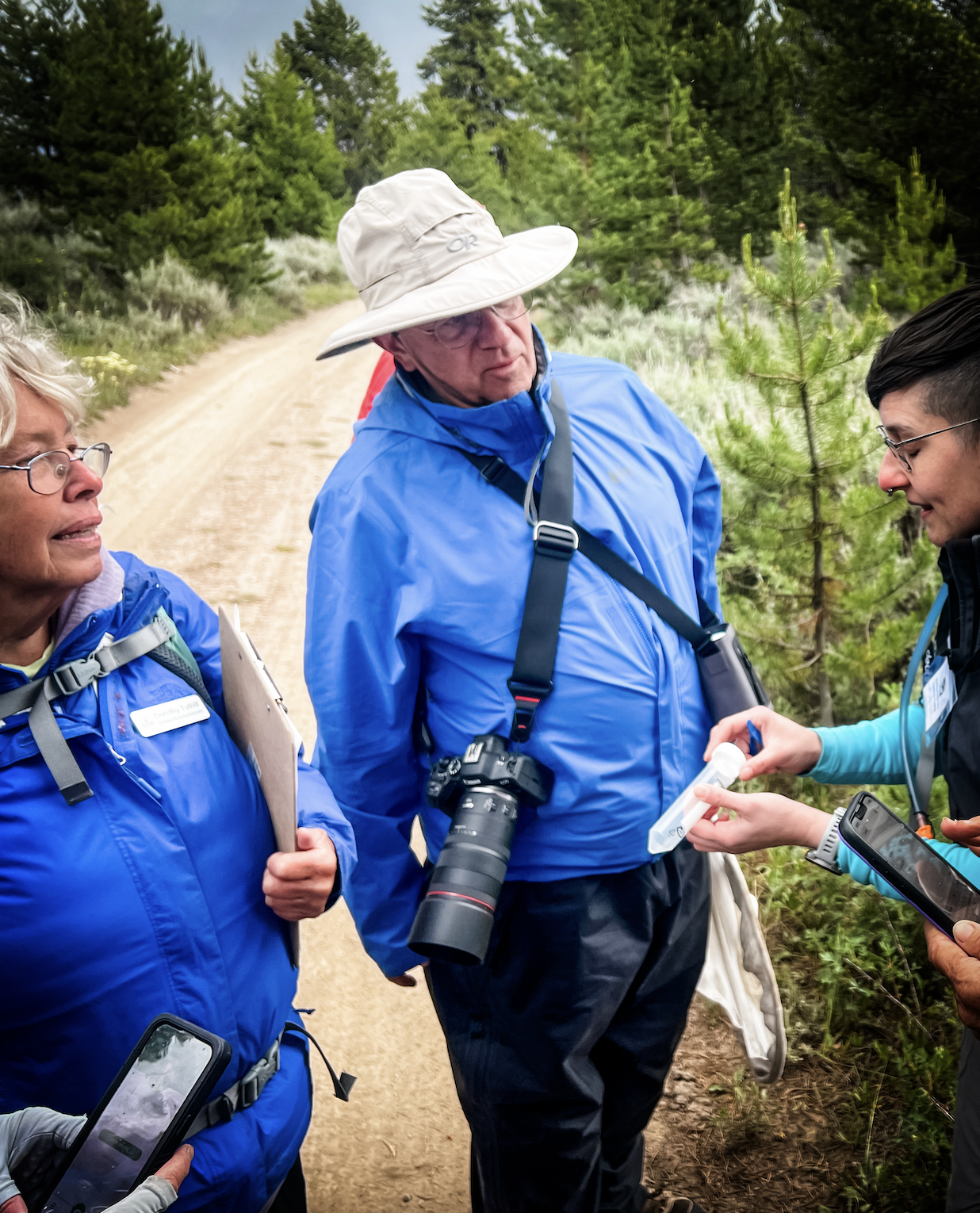
Kurt in the field.
Photo by Jess Ryan.
Nichole: We were chatting yesterday about what it meant to be a naturalist, and I wanted to pick back up on that. I had a deeper question. Why are you a Wyoming naturalist? Like, what does that mean?
Kurt: Okay. I live in Wyoming. So it makes sense if I'm gonna be doing citizen science, which is what the naturalist program is set up [for], and I'll get into that. But yeah, when I retired, I live in Cheyenne. So when I retired, I looked for a naturalist program because I started out as a biologist, then I diverted and did environmental law for almost 30 years. And so then when I retired, I wanted to get back to my science roots.
And so initially, I took the naturalist program for the City of Fort Collins, and I did naturalist work for the City of Fort Collins for about three years before I got into the Wyoming Natural[ist Program], 'cause Wyoming didn't have a naturalist program until 2021. It was one of the last states, I believe, to get a program.
And so I wanted to sort of give back to the public to hopefully encourage them to have the interest and the love of nature and science that I have. So when the program started up, I said, "Yeah, that's great." And the Wyoming Naturalist program, you don't have to be a scientist. You can have any major. And then there's a committee that reviews all the applications, and then they accept about two dozen to 30 a year, I believe it is.
And then it's a 12, 13, from like February to May. 12, 13-week Zoom, two hours a week training. And then at the end of May, we do a weekend camp out so that the new naturalists can sort of put to use what they've been training.
So they'll get like birds and reptiles and insects, geology. A good broad spattering. It's not gonna make you an expert in anything, but it's gonna give you enough background now, so if you see, "Oh, this state park or this agency wants a volunteer to do A, B, or C," if you have an interest in it, then you can at least when you apply go, "Yeah, I took the naturalist program, and I have an introduction to this stuff, so it's not like you have to train me up from the ground floor."
So it's to sort of get a pool of citizen scientists out there. And so, I mean, it's everything from education to going out and collecting samples and whatever. So it's just a real broad base.
And since I've been in the program, I'm seeing now that the state and the agencies and organizations around the state recognize that there's a growing pool of trained naturalists out there. I've been seeing more requests for a naturalist assistant in just doing tabling sessions. We're just gonna talk about pollinators or whatever, or we're releasing Wyoming toads. Or we're helping salamanders cross the highway. Whatever it may be, but there's a lot more all year round for organizations looking for assistance.
Because, well, with budget cuts, I mean, a lot of what's gonna go on in science and other areas is probably gonna be from the assistance of volunteers. Right. And it gives me, I mean, a lot of people when they retire don't know what they're gonna do. I knew I wanted to be a naturalist, and I wanted to go out and educate or do citizen science.
So, and what I always tell folks is that now that I'm retired and I'm [in the] naturalist program and do other things, I can be as active or as slothful as I want because my time's my own.
Nichole: Right. Can you tell me what the term citizen science means to you personally?
Kurt: It just... An average person, not necessarily trained in science, that collects data that can be used to further some scientific pursuit.
And a lot of people, you know, feeder watch, like the Christmas bird counts. I mean, it's stuff you don't have to have any training. You can go with groups of people or whatever. So it's just getting the general populace involved in recording their observations, for lack of a better term, to help.
'Cause like in iNaturalist, when we put stuff in iNaturalist, and it gets to the research level, two verifications of whatever you put in there, then other researchers can pull that data out of iNaturalist and use it for their research. And since iNaturalist is worldwide, you can have people around the world.
So if you're doing something that has, like, migration or whatever, you can pull iNaturalist surveys from birds, like the iNaturalist in Costa Rica, and then follow them all the way up the coast and up into, through Canada.
'Cause the pool of trained scientists doing that is extremely limited. So if they can pull from just the average person on the street adding some significant data to their pool, it helps everybody.
Note: The transcript above has been condensed from its original audio recording to improve the flow and readability of the story.