
Four Generations of Sheep Ranching
Gifted by Dorothy J. Davis
Gathered by Nancy Small
Gillette, June 2026
Dorothy reflects on her family's journey from Scotland to Wyoming and the sheep ranching legacy that has endured across four generations. Through stories of immigration, hard work, and family resilience, she traces how one grandfather's search for a better life shaped generations to come.
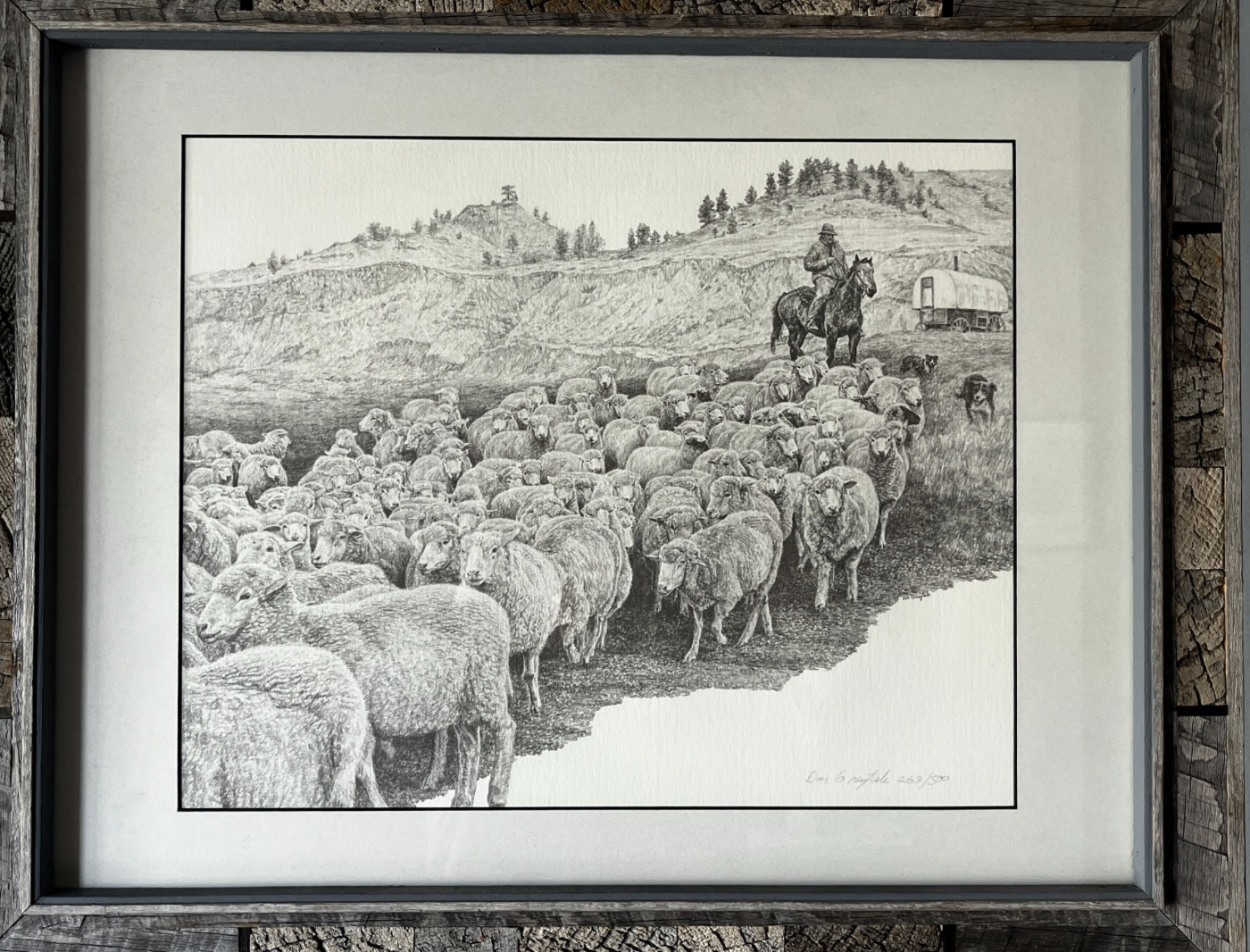
A piece of Dorothy’s artwork showing sheep herding. Photo taken by Nancy Small
Nancy: What were your parents like?
Dorothy: My, father died at 49. When I was just in high school, just finishing high school. So you know, your... It's hard to say, but my memory of him is so dim and so limited.
Dorothy: I can just remember he was a fairly quiet man. And he definitely, if he said, "No, you're not going to do that," that's what he meant. That type of father. But, um, and then my mother, after he passed away, she raised. We had a brother that was younger, just seven when my father passed away. So she stayed on the ranch and raised him, and my other brother was just in high school, so she had those two, and I, by that time I was out of high school. But, you know, I admired her.
Because she was a very young widow. Never married, never... Just raised the family and took care of the ranch.
Nancy: How did she do all that?
Dorothy: She was a Scotchman. When you said you were, uh, you'd been over there, I wanted to say, my mother was born in Scotland.
Nancy: Oh, where? Do you know where?
Dorothy: She was born near, uh, between Glasgow. There was a little town named...We tried to find it when we were there, but it's been absorbed. But it's between Edinburgh and Glasgow.
Nancy: Oh, yeah. Right in there. Yeah.
Dorothy: And then we have really good friends in Edinburgh. Oh, that's lovely.
Dorothy: We had been back there three- Just twice, I guess, but enjoyed it. Yeah.
Nancy: Yeah. Did your mom have that beautiful, um, Scottish accent?
Dorothy: Not a bit. No, she was born there. She came, her folks came to Wyoming from Scotland, and then when she was pregnant she went back to Scotland.
Dorothy: Okay before I was born, just, you know, being a new mother and lonesome for home and all that. So I was born, or she was born there, and so she came to Wyoming to stay then, oh, when she was three, I think.
Nancy: That's your mom.
Dorothy: That's my mom, yeah. Okay. That's why she had no accent either.
Nancy: Do you know what brought her parents to Wyoming?
Dorothy: A better life, they thought.
Nancy: A better life, yeah.
Dorothy: Yeah, her dad was a, uh, my grandfather was a tailor of all things. Worked in a lace factory. And yet he came to Wyoming and became a sheepherder and finally that's what he did for his living.
Nancy: So your great grandfather started the sheep business.
Dorothy: He did.
Nancy: Then your parents were involved in it.
Dorothy: Uh-huh.
Nancy: And then you were involved in it. And now your son continues on?
Dorothy: Now, uh-huh, yeah.
Nancy: So great. Four generations. That's remarkable. Yeah.
Dorothy: Yeah. But so many of those Scots people came. And they came, I guess, because it kind of reminded them of northern Scotland, cold and- windy and all those other not so pleasant things.
But a lot of them did so. My grandfather had, you know, friends and relatives here, when he came as, well, they were almost all of them in their teens. Young, young guys coming to because it was a better place. And most of them made, made it a better place for themselves too, you know.
Nancy: Hard work.
Dorothy: Hard work is right.
Nancy: It sounds like you've traveled quite a bit actually, because at first you said you hadn't been out of Wyoming much. But now I've heard you mention both Hawaii.
Dorothy: But that was all in late… and Scotland, later, way later years.
Nancy: Well, you're a whole person. You've got your whole life.
Dorothy: Yes, we went to, like I say, Scotland a couple of times, Australia, and New Zealand. Which we really enjoyed. Uh, which rather, rather a, a joke among some of our friends when they said, "Well, what all did you do?" And I tell you, when we went to New Zealand and Australia for a month, that is not, that's like the tip of the iceberg, because Australia's bigger than here.. So we did not see a third of Australia. And I, when, anyway, when they would ask what we did, "Well, we visited sheep ranches." Oh. That's what they, "You mean you went how many, 7,000 miles to see a sheep?" But that was one of the reasons we went, because our shearers- that sheared our sheep here in Wyoming- Yes were from Australia. Yes. And we became real good friends with some of them.
Nancy: That's fun.
Dorothy: So when we went to visit them. And we had a, a, a couple ranchers that lived beside us. He was a Basque. And they raised sheep. So they were very, very good friends of ours here in the United States.
So they went with us, we just had a wonderful time because sheep was all they knew too.
And we visited Australia, mostly sheep. And then in New Zealand we just barely, it seemed like we barely saw it, because it was raining when we got there so terribly bad we couldn't go north on the North Island.
Nancy: I think to survive being a sheep farmer and raising kids in Wyoming, you have to have a hard head.
Dorothy: Probably helps. Don't say sheep farmer.
Nancy: I'm sorry. Sheep, sheep rancher.
Dorothy: Rancher.
Nancy: Apologies. Or herder. A herder.
Dorothy: I was just reading a book, right, last night about some of our Scottish friends, that their daughter had written. And, what did she say it was called in Scotland a flock master or something. A flock master if you owned sheep. I think that was the word she used. And then when they came to the United States and here in Wyoming and that name didn't stick here. Huh. But the people who took care of the sheep, a sheepherder. And that was, she said, in early times, that was about as low a job as you could get. People didn't think much of you even if you were a sheepherder.
Nancy: Exactly. When you had your sheep ranch, did y'all have herders that went out further? Or so your ranch was small and contained enough you didn't need that?
Dorothy: Nope, we never herded our sheep. The only type of herding when I was growing up when I was just into high school, we used to, we had a big enough pasture that we wanted to keep our sheep that hadn't lambed separate from the ones that had. And it wasn't hard to do. Except I was the sheepherder one day, and I don't know whether I was reading a book or doing some silly thing kids do. Anyway, the sheep had one general watering hole. So that was the main job. You'd want, didn't want them to come from both sides at the same time.
Well, by the time I came to, there was a string of sheep headed at the wrong time, and oh my gosh, I was so scared. I thought, "This is gonna be the end of my life, if I let those sheep mix!" Because, you know, then you've got all of them together. You can't tell a mother from the unmother. And I got there in time.
I thought maybe one or two got mixed up, but I thought, "I'm not even gonna say. I'm just gonna tell my dad the sheep just about mixed, and that'll work." And I must have survived. I mean, the truth must have been there, because we never had any show up, but-
Nancy: Phew ...
Dorothy: Yeah, that. But other than that, no, we didn't have a big enough place, and my husband and I definitely didn’t.
Note: The transcript above has been condensed from its original audio recording to improve the flow and readability of the story.