The Meaning of It All? Community.
Gifted by Lou Farley
Gathered by Nancy Small
Laramie, July 2026
Lou serves as Spiritual Director & Bereavement Counselor for Hospice of Laramie. This story about his work in that role--how he came to it, what it means to him, and what it teaches him--reminds us that the very best of ourselves often emerges in the toughest of times.
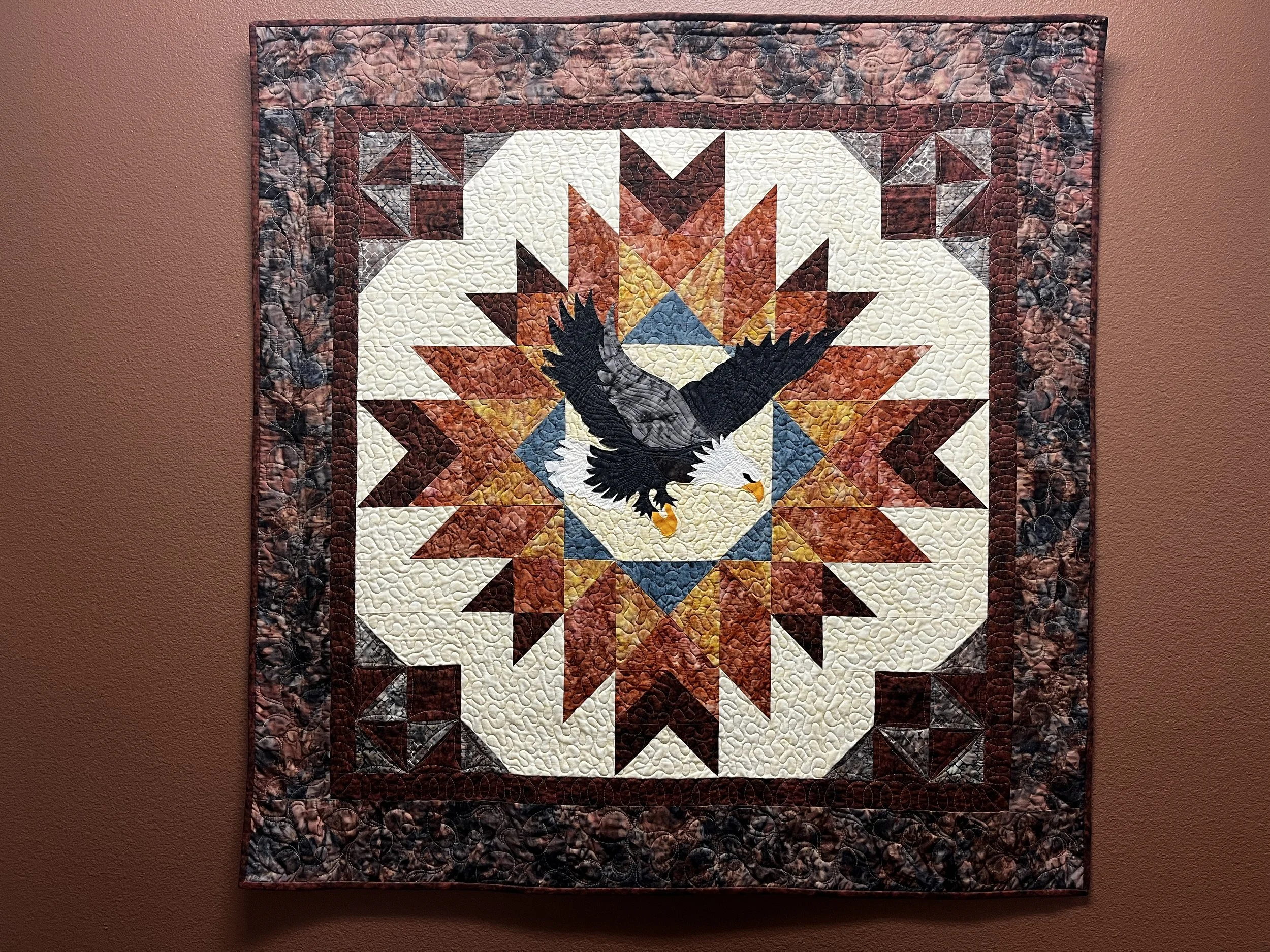
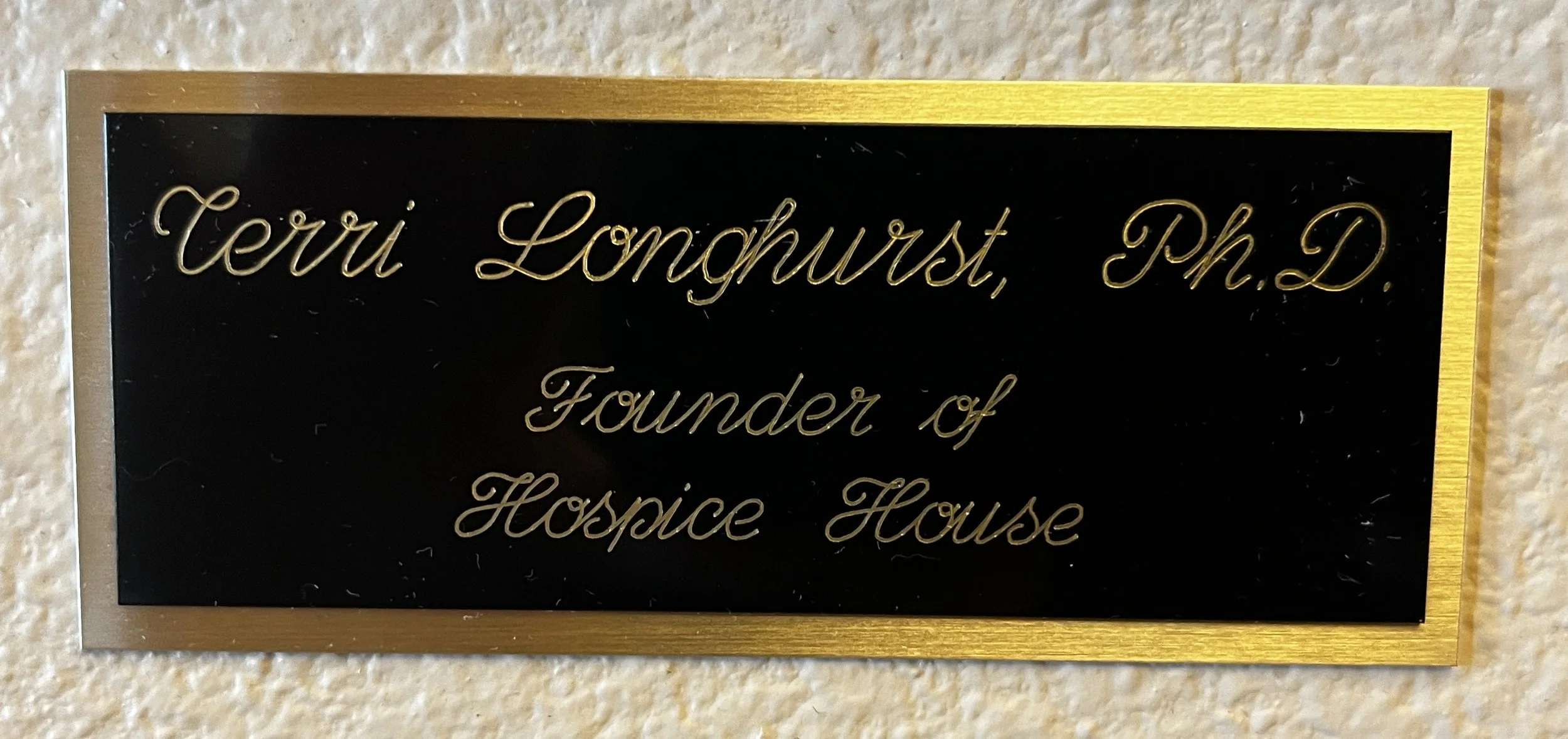
Hospice of Laramie was founded by Dr. Terri Longhurst. Her spirit and beautiful quilting talent still linger in the welcoming space.
All photos by Nancy Small.
Nancy: From my own personal experience, not with the Laramie Hospice, but with other hospice professionals…It is an incredibly meaningful support system, as well as individual humans that volunteer at hospice are always just the best humans. It's like when you need that, you need it in ways that are indescribable. And so I'd love to hear more about what it's like to be part of Laramie's hospice community.
Lou: When I was 60, I'm 66 now. This is no kidding, Nancy. I used to volunteer for seven years when I had a private practice for hospice. Two days afterward, I tell my wife [Barb] privately that I'm going to close my private practice and all I want to do is ride my bike. I want to take my dogs for a walk. I want to go to the mountains. Two days after that, I'm at lunch with the fellow who was then the director of [Hospice] operations, and we're at Anong's, and we're sitting across from each other, and he says to me, "We have a question for you."
Nobody knew this [part of the story] except my wife because I thought it was presumptuous and intrusive. They had a nice chaplain here, named Rhett Ivey, and I thought, "You cannot tell anybody that you covet his job." Except Barb, because she's my best buddy.
So I said to Barb five years prior to being that, sitting at that table, I was putting it out, "I would love to be the spiritual counselor and bereavement counselor at hospice. I would love that. I would love that. I would love that," for five years [I kept saying it].
I sit down with Jeff , and he says, "We have a question for you." And in my head I'm like, "Please let it be that question. Please." And I don't even know who I'm talking to, right? Please let it be that question. Please let it be that question. And he says, "We would like to ask you to come on”--this was two days after I told Barb I was going to retire--"We'd like you to come on in these roles [at Hospice]. Are you interested?"
And I, my tears started coming down my face, and I said to him, "You would have no idea what just happened, but that is an answer to a five-year prayer. Yes, I would be glad to do that for you." The next day I was hired at Laramie. It took me a year to close my practice and then move full-time into hospice.
What it's like working for hospice…I would prefer to talk about it from the mystical side.
Nancy: I would love that.
Lou: The mystical side of working at hospice connects with existentialism. There is a constant reverberation of ”Do you get what's happening in life? Do you get what's happening in life? Do you get what's happening?” And that's exactly what I wanted. I think that's exactly what was motivating my five years of silent prayer. I wanted to know, like, what is this really? What are we really doing here beyond philosophy, beyond cognition, beyond sociality, beyond verbiage? What is actually happening here?
Hospice affords me contact in such a way that I feel really--not to be too corny--I feel blessed to get some kind of resonance that answers that question in a deep way. So if somebody said, "Well then, what's the answer? You've been here seven, six and a half years with hospice professionally…What is happening here?"
And what I would say is that…it is more than I could have ever asked for: to say, to understand that community is the foundation of human wellbeing. Whether it is a birth or whether it is at the end of life, community, compassion, love, working together, supporting each other, being kind to each other, being unconditional with each other... is always medicine.
We may not have access to the medicine that cures pancreatic cancer or brain cancer or Alzheimer's or ALS, but there is some thing that is true and is inherent medicine: it's those qualities, that [sense of] community.
So working here is…If somebody said, "Well, what do you do for a living?" I’d say, "Not a lot, actually." But what is getting done is I'm always working with the intention of enhancing and deepening the sense of community between our employees (among themselves), between our Hospice of Laramie and the community, our Hospice of Laramie and with a patient that comes in terrified or a family that comes in grieving. There is this community that is here, and it's trustworthy, and it is compassionate, and it is loving, and it is on the verge of unconditional.
I think that has real power. If it's okay, I’ll connect it to what we were talking about earlier, about what has surprised me in Wyoming. It is that on a personal basis, I see people who generally get that [about community] in a deep way. If you're hungry and you pass a Wyomingite, they may give you half their sandwich easily. They may drive you someplace. If you're in pain, they may take you to a doctor.
That community, I do believe still exists in Wyoming,
Nancy: Thank you for sharing. I appreciate you, and I appreciate what you do to keep that part of the community warm and existing. Because it does take a community to make a community, and you're part of that network, so thank you. That was beautiful.
Lou: Thanks for asking, Nancy.
Nancy: It's an honor to sit with you today.
Note: The transcript above has been condensed from its original audio recording to improve the flow and readability of the story.