
A Rude Awakening
Gifted by Sharon Hand
Gathered by Misty Springer
Laramie, June 2026
Sharon did not realize how sheltered her life in Wyoming really was until she travelled all the way to Texas on her own. Sharon was just seventeen years old, the year was 1959 and it was the first time she witnessed systemic racism.
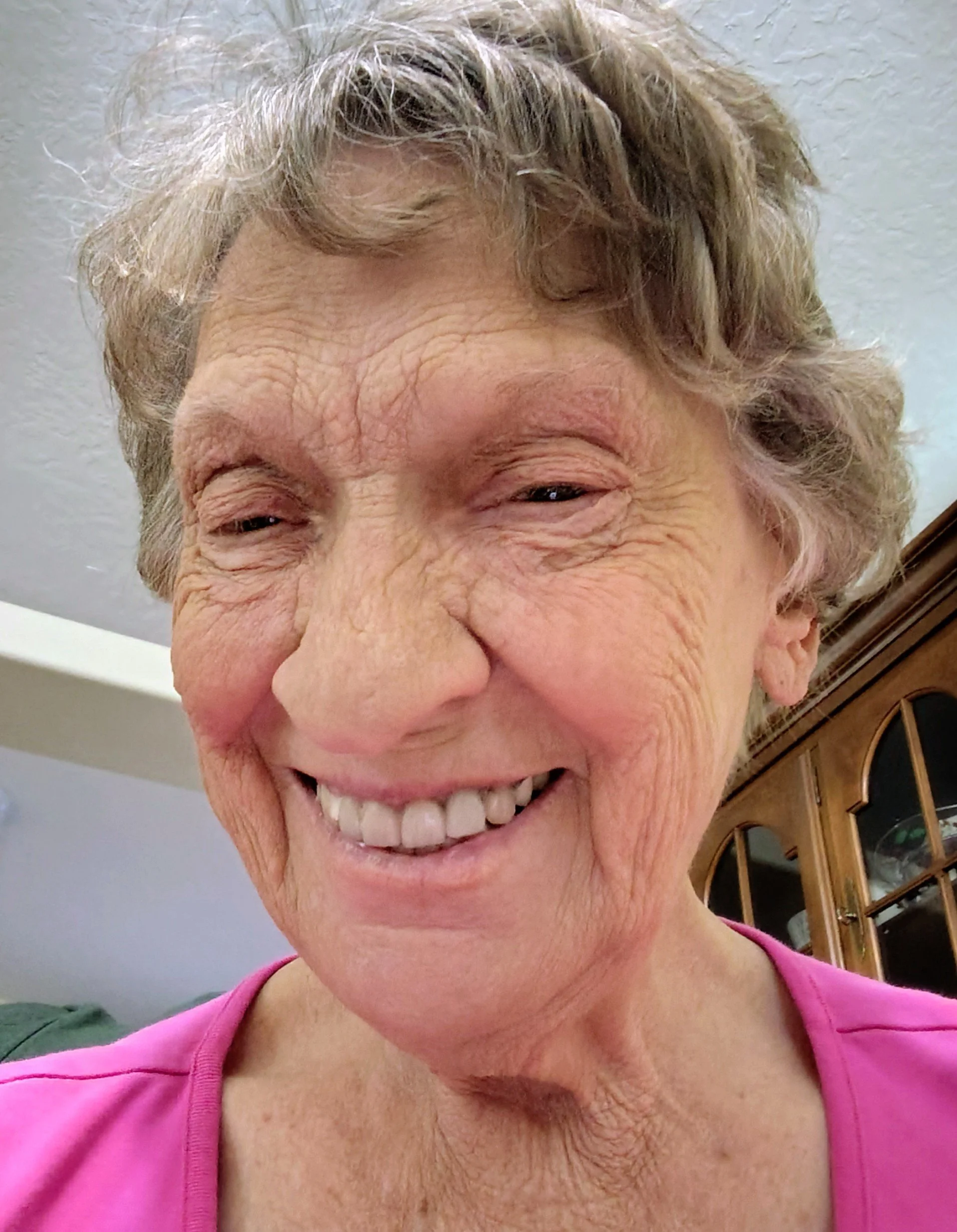
Self portrait courtesy of Sharon Hand.
Sharon: I am thinking that Wyoming people might be interested in what happened to me in about 1959, before the Civil Rights Movement. Wyoming just had very few Black people, and the one Black family that we did have in Casper, he was quite popular. There was probably a whole family, but I only knew this one gentleman, and he was, um...Everybody loved him. They just didn't look at his color. And so that's why I wrote this story. I called it, I Was Colorblind But I Didn't Even Know It.
Well, I was, always wanted to be an airline stewardess.
And I had to apply all over the United States because there was nothing in Wyoming really. And at one point, and American Airlines would take you if you were 17. So when I was 17 going on 18, I applied to be an airline stewardess. I thought it'd be so great, and my family wasn't too happy about it. They, thought I'd be a glorified waitress is what they called it, but I tried.
So I went to, first Denver, and then in Denver I got on an American Airlines. And when I landed there, they told me what to do, where to go, and I got on a bus and went to the hotel. When I got on the bus, I went to the back of the bus. You know where this is going, don't you?
And I sat down and I thought, "Wow, they really do have a lot of Black people in Fort Worth." But I didn't think too much about it, and got off the bus and got into my hotel room, and my hair was a mess because of the humidity. So I tried to get all cleaned up and everything, and took another bus to where the interview was. And again, I get on the bus and as usual, I would always walk to the back of the bus. In Casper, you just did that. And I did. Got off the bus and went into the waiting room, and I sat there waiting and I thought, "I'm the only white person here. They're really applying for, s- stewardess jobs?" That, okay, that's the way it is here, you know?
So I went in and visited with the man in charge and, uh, he says "Where are you from?" And I said, "Well, it's on my application there. I'm from Casper, Wyoming."
He said, "Did you see the signs out there?" And I said, "What, what signs are you talking about?" "About where you were sitting. You were sitting in the Blacks only section." And I really was shocked. I mean, I said, "What? I, I, I don't know what you're talking about."
He says, "You were sitting in the Negro section."
"So?" And, uh, he says, "So never mind." He did add this. He says, "You know, in Fort Worth, we're not as bad as some places. We let them get on the bus and walk to the back of the bus. But in some cities, they have to get on the bus in the front and pay and get back off and walk to the back of the bus and get on the --
Misty: Oh my goodness
Sharon: chair in the back." He told me that. I could not believe that. I thought it was I just couldn't believe they treated people like that. Um, well, he says, "Do you have any other questions?" And I said, "Well, I don't have any other questions, but what about sitting in the wrong section?"
He says, "You're in the South now, and we're segregated here, and, that's why you just shouldn't have been sitting there." And, he said, "You be sure when you go back, you don't get in the back of the bus. I bet you did that." And I said, "Yeah, I guess so." And he said, "Well, get in... You know, be sure and do it correctly."
And so I did, and I, needless to say, I did not get the job. I, I don't know if it's because I was naive or too young, because I was pretty young and most of the airlines didn't take you at that age, but they did.
I did mention about my, the one Black family we had.
And, I can still picture him leading the band, you know. And his, high-stepping, you know, marching and everything. And that was the only Black family I knew. And I only knew him. I didn't know the whole family.
Well, later on, I met somebody at Mobile, Oil. I used to work for an oil company there in Casper, and, he was from Alabama, I think, and I was telling him this story, and he said, "Oh, yeah." He says, "You know, they have different schools, too." I said, "No. I... this guy in Texas didn't tell me about that." He said, "Oh, yeah. All the Blacks go to a different school."
And I said, "No. Why would they do that to somebody?" And, he went on to tell me a lot more things from Alabama, and this was in the '60s, late '60s.
Note: The transcript above has been condensed from its original audio recording to improve the flow and readability of the story.