
Science and Colors Together
Gifted by Erin Bentley
Gathered by Jess Ryan and Nancy Small
Pinedale, June 2026
Erin Bentley explains Kaleidoscope Science, a project that combines science outreach with printmaking. She describes how participants use color, art, history, culture, and science to build a layered understanding of native plants, especially the Wyoming paintbrush.
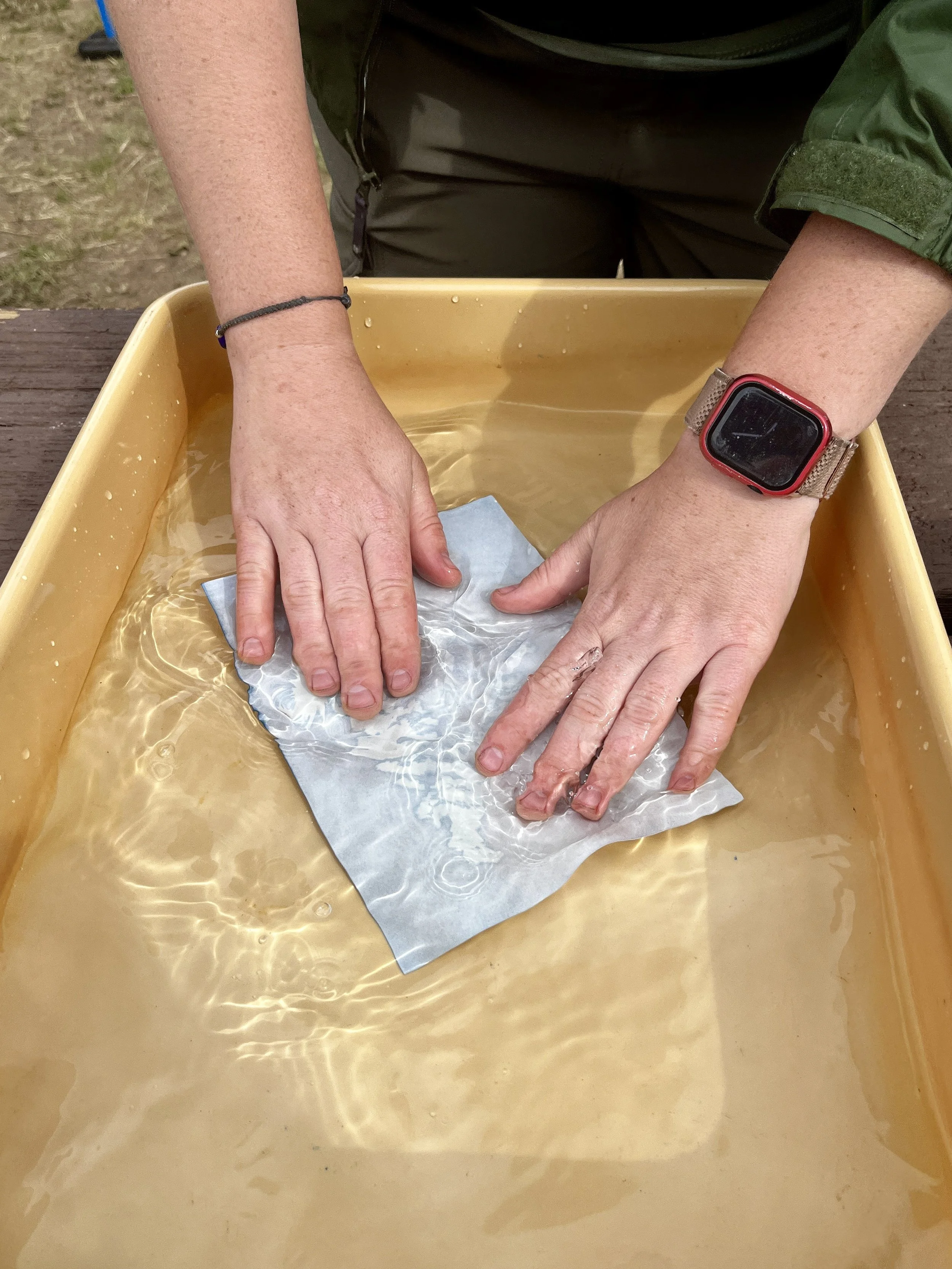
Photo by Nancy Small
Erin: Kaleidoscope Science is a project that combines sort of a holistic approach to science outreach with printmaking. Specifically, it was inspired by how Warhol does his combined prints where there's a motif that follows even though the colors change.
So working with Lars Roeder at the visual arts department, we came up with this idea that you could assign a color to a lens. So when I say lens, I mean, like history is yellow, and art is red, and science is orange, and culture is blue. So then we build a four-color screen print that incorporates all of those colors into the print so that when people do it, you're sort of symbolically building your understanding of an organism or of a place a layer at a time, a color at a time, a lens at a time.
And we actually combine this with a bit of an active learning activity. So what we do generally is we have people work in home teams where everybody on your team is doing the history of... And for community events we usually do Castilleja linariifolia, which is the Wyoming paintbrush, which is the state flower. So we usually work with the state flower and the herbarium's one millionth sample of it.
So, herbarium surprise, yes. The Rocky Mountain Herbarium has over a million samples. It's really quite remarkable. I think that they are in the top 14 largest herbaria at a public institution in the United States. So they're big, and they're so cool. The herbarium is so cool.
So this project was actually started as part of an idea on how we could do herbarium outreach and build public knowledge of herbaria, because recently, in 2024, they actually announced the closing of the Duke Herbarium, which is this huge, really important institution that they are closing.
And you have to refind all of the homes for those specimens, and you lose a lot of the, speaking of this transdisciplinary approach with these different lenses, you lose a lot of the institutional history of not only the Duke Herbarium, but all of those specimens, all of those collectors, all of those people that probably really had an important tie to the place that is the Duke Herbarium are now sort of scattered to the other herbaria that can take in those samples.
So part of this goal of Kaleidoscope Science was to build public knowledge of the herbaria and of native plant diversity and why that matters. So we do this activity with the Wyoming paintbrush because it's something that people recognize, right? And they're like, "Oh yeah, that's the state flower."
What they don't know is that there's like 200 species of Castilleja. Like, there are so many, and like 100 of them are red. So you can't just be like, "Oh, the red one is the state flower." That's super wrong. And so that's kind of funny, and that's something that comes up. We get that a lot out of people who participate in Kaleidoscope Science. They're like, "I had no idea there were this many of those." And I was like, "Yeah, you can tell because almost every logo in town that has the state flower is not the state flower."
So, you know, it's a symbol of the West, even if it's not linariifolia. But yeah, so to circle back around, I guess, we have people do these home teams where they'll research, how, where does Castilleja show up in history, or how was Castilleja used culturally, or what's the science behind Castilleja, and that kind of thing.
Each team is made up of however many, usually about four people. And then they do a printmaking activity where they print just their color on the print, but then together, like each station, there's one station that prints red, one that prints blue, one that prints yellow, one that prints orange, and they collectively build it.
And then we have them all come together with their almost-done print, and we scramble the teams so that you then have a team that has one person from each lens on it, and then they teach their new team what they learned on their old team. So then everybody sort of has this broad understanding of the paintbrush.
And then from there, we ask them to come up with a question or a research question that integrates multiple lenses. So like a question that has both culture and science, right? Like it could be, did, like, does the cultural use of this flower by Native American tribes in the past influence where you find it currently? Right? Would be an example. So you have a cultural use as well as current scientific range and dispersal. That's an example.
And then they come all together, and then they print the line layer. So the line layer is the black layer that kind of actually puts the picture into focus a lot of the time. And then they get to leave with their print.
So we usually do a pre-survey and a post-survey to be, you know, like, what did you learn? So actually, we do see a sort of statistically significant increase in these Likert questions that we ask. So we ask things like, "I understand what an herbarium is," or, "I understand why an herbarium is important," and things like that.
And we do actually see that with people who participate in Kaleidoscope Science, they walk away with much improved knowledge of what an herbarium is and why it matters, and more about native plant diversity, and things like that.
Jess: So I'm curious, and I'm sorry if I missed this. But how do people get to Kaleidoscope Science? Like, how do they get... Is it just open to the public and you put something out? Do you go into schools? Like, how do they access it?
Erin: Yeah. So there are two aspects of Kaleidoscope Science that we do. One is this public-facing one that I've just described.
One is what we call an expert event, so that's where we invite specific people to come and do this event with... I have a personal goal of measuring how both the public and professionals see transdisciplinary work, and what their perspectives on transdisciplinary work are. So that's sort of the point of the expert events.
But so for expert events, we send out direct invites usually, or we get approached. So I've been approached by a couple of different grant groups that want to do it, and we design something specific to their grant, and then they do it as a whole grant kind of. So that has happened.
For our public events, we usually post them places and invite people to come. So they're usually open to anybody who's interested. We just will put out, like, "We're gonna do this on this day. Please RSVP via this Google Form," right?
Or we actually did it at Science Loves Arts Pollinator Festival a couple of years ago, where we just set up a booth and did it. But yeah, it's just sort of broadly accessible and available to the public wherever we do it, and we'll send out, like, we'll post flyers and do that kind of thing whenever we do a new event.
Jess: How exciting. I have a non-Kaleidoscope Science question.
Erin: Hit me.
Jess: Your bracelet. You have an evil eye bracelet.
Erin: I do have an evil eye bracelet.
Jess: So what does it... Tell me why, like, what made you...
Erin: So I got this in Spain, actually. I was invited to talk about Kaleidoscope Science at the International Botanical Congress, which is like a conference that happens every six years. And it's somewhere international.
So I got it because I, like a lot of science folks, I think... Well, not a lot, but some, I think that there's a niche of science folks that also lean into, like, how do you explore your connection to the world?
Note: The transcript above has been condensed from its original audio recording to improve the flow and readability of the story.