
The Book That Built a Bridge Across Time
Gifted by Morgan Rosado
Gathered by Nancy Small
Gillette, June 2026
After discovering a discarded copy of The Last Garage Sale at a Campbell County Public Library book sale, Morgan embarked on a remarkable search for its author. What began as curiosity grew into an unexpected correspondence that connected two generations through shared reflections on Wyoming, art, environmental stewardship, and the enduring power of stories.
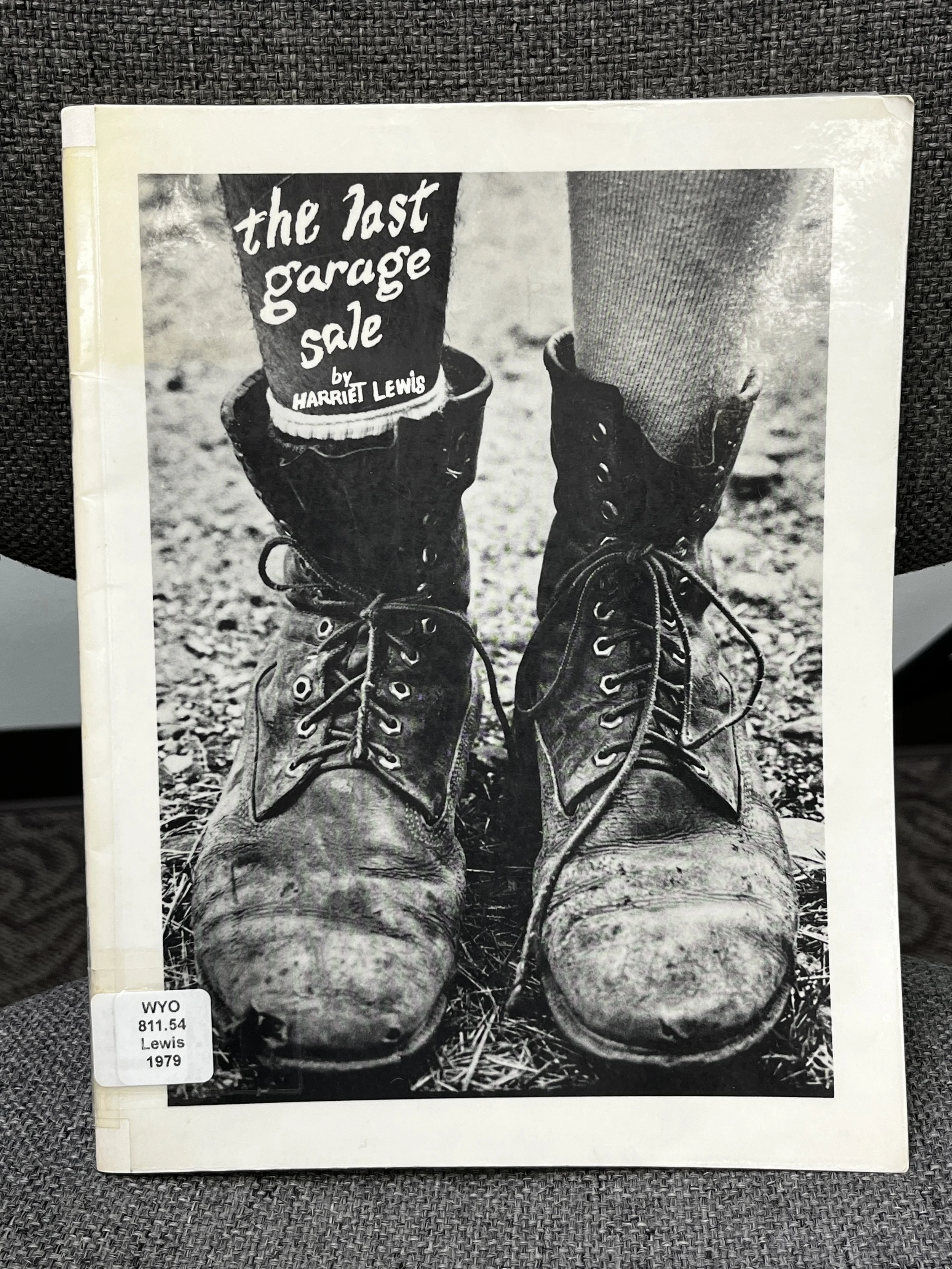
The book discovered by Morgan at the Campbell County Public Library book sale. Photo by Nancy Small.
Morgan: The story that I'm going to tell you isn't really about me. It's a story of connection that began basically decades and decades ago, before I was even born, but one that only managed to happen just because of the luck of happenstance and because I think there was a shared need for change that I felt within myself and also in what I found.
Essentially, in 2023, the Campbell County Public Library, they had a rare and vintage book sale. And as I was perusing the tables, I found this, which is The Last Garage Sale by Harriet Lewis, also known as Harriet Green. And it was published in 1979. And for reference, I was born in 2002. So it's probably clear why I picked it up.
It's a photo journal with prose rather than a typical book. And I feel like it could, the story within it would resonate with many people, and why they chose to come to Wyoming, because I, myself, am not native to Wyoming. But basically the story is, Ms. Green, after a recent divorce, decided to move from Vermont to Wilson, Wyoming, with her then partner, Martin Goldman. And the pair took photos of all the items at the garage sale. So, like, their, their dearly beloved items, all those memories, the people that came, and, like, of the home itself since they were leaving it. Oh, geez. Within the story of, Miss Green tells of her past and her heartbreak, the fears of modernization and the encroachment of capitalistic progress, and a hope for a new life in a faraway place.
And I think it's best shown in an excerpt from the book. "We were going to a new place where they were still fighting. It is necessary not to dam the river, build a bigger airport, destroy the delicate balance of nature. When this planet becomes cementified and pavementized up to the gates of the wilderness areas, Wyoming may still be fighting, warding off the enemy of progress. Progress is what some call their fight for power as they progress to fill their pockets and personalities." The feelings and emotions captured by Ms. Green really stuck with me. It just goes to show, uh, just how much of our modern concerns and problems aren't a modern invention. You know, they're ones that the generations before us have been fighting for their entire lives.
'Cause my family originally moved to Cody in 2008 when I was only seven years old to escape the urbanization of Lancaster, Pennsylvania, and the quality of the school systems. And given the uniqueness of this story and how meaningful it was to read, I went on a mission to find Ms. Green and to see what else she had done in decades since- cool... and to tell her how much The Last Garage Sale meant to me. But to describe what I went through as a rabbit hole would be selling it really short. The internet has changed to basically be unrecognizable through the years. And though I had the names of, and the ISBN to go off of, so much time has passed since its publishing that seemingly all I could find were dead ends.
Even still, I learned so much going through it all. Ms. Green is not just an author, but an artist, a sculptor, and a woman that's dedicated her life to art and how she's experienced the world. Martin Goldman was also a successful artist and author, as well as a film director and screenwriter. From years-old interviews and to find the couple's old what their from years-old interviews and fine art listings, more and more of the picture became clear. And up until I managed to find the couple's old website, one that shares the name of the bibli-, the business they'd established in 1979 to publish The Last Garage Sale, called Backroads. And from there I was actually,
There's this website called The Internet Archive. And I used the Wayback Machine to look at the website from 2018 'cause that was the only version that was functioning. And from there I found an email address, and I just figured, you know, there's like, there's no way that it's still working or that anyone's gonna read it, but I still sent the email anyway, and then she actually responded to me the exact same day that I sent it. And, through our conversation, we shared what was going on in our lives. At the time, in 2023, I was still working on my associate's degree at Gillette College, and I wasn't really sure what I wanted to do or where I was moving forward in my life. But for Ms. Green, she shared that, unfortunately, her husband had passed away the last year.
And to quote her, she said, "I'm living all alone with all our books and artwork and wondering what to do with it all." But despite those troubles, she's still been working on her art.
For many years, since 2007, she's been working on a project called Sculpting for Peace, and it's these massive marble pieces that spell out the letters peace, and she's engraved one side of them with quotes from peace activists and Nobel Peace Prize winners. And on the other side, she has images of doves flying through the lettering.
And, yeah, and to this day, when I reached out to her to tell her about Restoring the West, Sculpting for Peace, the physical marble piece and the book are still being carved. But I believe an important aspect about Wyoming as a state is its transient nature, both the good and the bad.
Many like Ms. Green and my family come here to step back into nature, to live smaller, quieter lives, and to escape a lot of the urbanization and suburbanization consuming the United States. In that, many leave Wyoming as well. Every year, college graduates depart for greener job markets.
The state swells and lulls with the seasonal workers for farming and tourism, and there's the constant push and pull of the oil fields and coal mining. Our public land, like Madison Bow National Forest, is threatened to be sold. Data centers and crypto millionaires move in, and just like the snow that buries and puts Wyoming to sleep for half the year we come back each summer to new qualms and worries, and we must decide if our small state should even be bothered caring about it.
And the last garage sale unfortunately ends in a tragedy. The old maple trees that had lined the roads between the homes on Randolph Road where they lived were all being cut down in service of power cables going up.
And despite Ms. Green's protest and her attempt to save just one of the trees, in the epilogue she says, "The maple I saved died by their axes when the van disappeared around the bend into the northwestern sunset." I like to say in the end, though I'm grateful I can remember and shine a light on the life of Harriet Green and the joy that can be shared from just a coincidence. You know, if I hadn't been there that day at the library, if I hadn't picked it up, if I hadn't, you know... It's just there are so many links 'cause searching through the internet all these little trails that just happened to line up is the only reason why I was able to talk to her.
In the end, it's so much of the past building up to the future that I'm left wondering one question that I think echoes through a lot of people in Wyoming because we're such, I think, like you were saying during the talk, you have to change your energy 'cause other, in other places people are just like so open and friendly.
But here it's just kind of like, you know, keep to yourself, bootstraps, pick yourself up or whatever. With our current world, you know, how much are we willing to give away until we can say- it's not our problem anymore?
Nancy: That's beautifully said. Really well said. Can I ask you one follow-up question? So I love the serendipity of you finding this book in the, like, library sale. And also funny that it's called The Last Garage Sale and you found it at a library sale.
Morgan: Yeah, I mean, it literally has a discard on the barcode.
Nancy: You strike me as a very curious person- yeah... because that's what sends you into like the research mode.
Would you ever like follow a, I don't wanna call it a rabbit hole either, but would you ever follow, follow a trail like that a- like could you imagine coming to another book sale?
Morgan: I gotta say, honestly, I do it all the time. It kinda, it's a really, it's a big hindrance 'cause I get so distracted.
It's like I'm writing something and I look up a word, and I'm like, you know, like everyone asks themselves questions like, "I wonder why that word is, you know, the way it is or what it sounds like." But for me it's not just, oh, Google the etymology. It's like follow every single other tab that opens and then there's another question, and there's another curious thing. And then I'm like an hour later I'm trying to get back to what I was originally trying to do, and I'm like- ... which tab was it?
Nancy: It sounds to me like you have the makings of a lifelong learner. That's beautiful. Thank you so much for sharing your story.
Morgan: Thank you.
Note: The transcript above has been condensed from its original audio recording to improve the flow and readability of the story.