
Women Who Held the Canyon
Gifted by Erin Bentley
Gathered by Nancy Small
Pinedale, June 2026
Erin Bentley reflects on her family’s deep Wyoming roots, including generations of ranching near Lander, Sinks Canyon, and Ten Sleep. She shares a sharp family story about her great-grandmother, a skilled shot who defended the family property with confidence and wit.
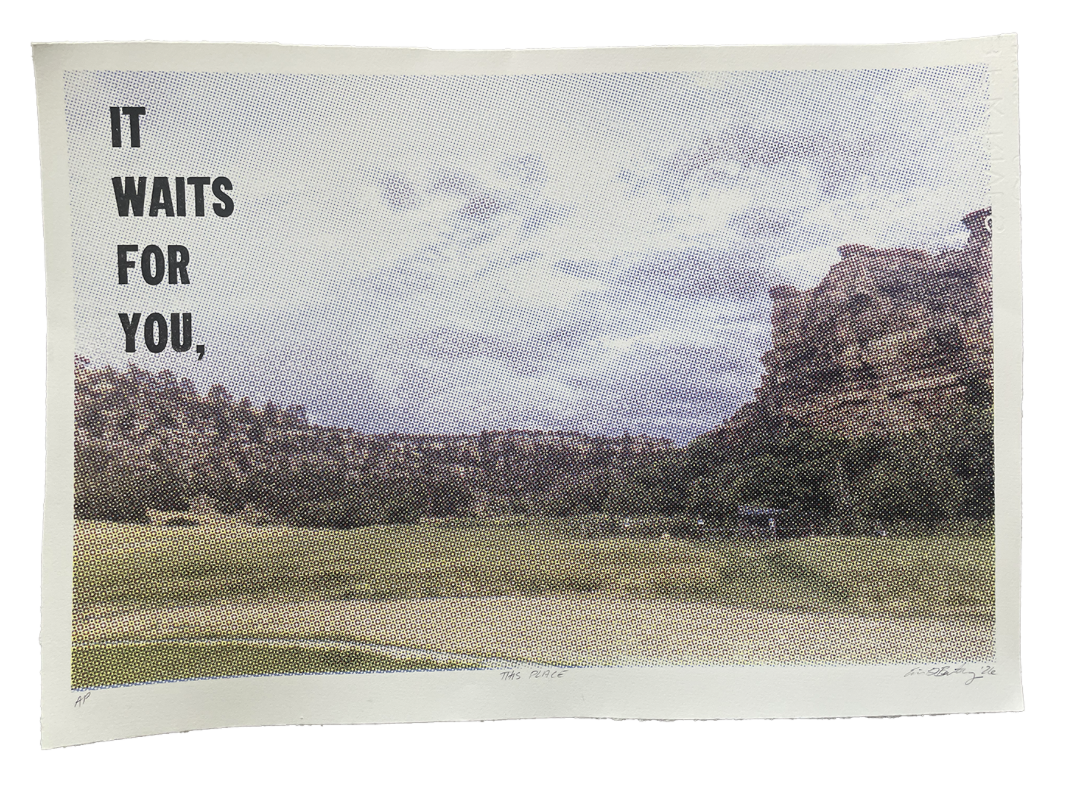
This Place, screen print and typeset on paper featuring the Ten Sleep canyon. Created by Erin Bentley, 2026.
Erin: Yeah, well I guess I was born in Wyoming, so I'm fifth-generation Wyoming. So my family actually homesteaded in the Lander Valley, in like the Sinks Canyon area. We used to have a ranch, and we still have a ranch up in Ten Sleep. So yeah, we've been here a long time.
Nancy: Is it cattle, sheep ranching, both?
Erin: Sheep. Yeah, so I think that the ranch up near Sinks was cattle, but the ranch that we still have is sheep. So there's lots of potential stories to tell, I guess. Let's see. What's a good one?
One of the ones that our family likes to make jokes [about is] that the women in our family have really good one-liners. And one of the ones that comes to mind is my great-grandma lived in the canyon up outside of Ten Sleep, and she was like a crack shot, like really, really good. Really just like a sharpswoman.
And we used to have problems with people sneaking into the canyon to fish 'cause there's a creek that runs through it. And so she would shoot the bluff above their head or shoot the tips off of their fishing poles when they snuck in to fish illegally on her property.
And at one point, someone approached her. He was really, really, really mad and was ranting about it, and he comes up on the porch and he's like, "I'm gonna go tell the sheriff that you tried to kill me."
And her response was, "You go get the sheriff, and I'll show him that if I wanted to kill you, you'd be dead."
Erin: Yeah. And so there's just this series of these really great one-liners, largely from the women that lived in that property. Which is kind of cool, you know, these women that were sort of holding down these cabins and doing these things while the ranchers were out ranching.
Nancy: So you have five generations, and then this is part of your life, too. What do you think it is about Wyoming women?
Erin: I don't know, you know. I think that Wyoming can be a harsh place to live. And a lot of the times, it's five generations on one... Both sides of my family are from Wyoming from several generations. So it's five at least on one, and maybe three or four on the other.
And I think that there is almost an expectation of survival. And I think that expectation can sometimes make you be really independent and be really self-sufficient and be these things that [are], I think, pushed on by the landscape itself.
I read somewhere somebody said, like, you know, it's easy to love the mountains, but it takes like a soul to love a prairie. You know? And I think that kind of carries through.
Nancy: I also feel like Wyoming people, I've been here 10 years, I feel like people in Wyoming are exactly as you're describing, but they're also quite unexpectedly loving and kind as well. It can come across as a kind of like, not a hardness, but people are a little bit like, you know, they have to be self-sufficient. But also they're amazingly sweet humans.
Erin: Well, I think that in a place like this, you don't survive without a community. So even though I think a lot of the times they are, you know, cold seeming, like, I don't know, my grandpa, I don't know that throughout my entire life he spoke more than 20 words, right?
But he also, like, when somebody was sick, he would go by their house every day after work, and he never told anybody that that's what he was doing. He would just go and he would sit with this person, and he'd spend an hour talking to them. And nobody in our family knew that he did that until that person came to his funeral and told us. Right? And so I think that it is, like, Wyoming breeds these people that are maybe sort of interested in their own solitude, but they are not without community.
Note: The transcript above has been condensed from its original audio recording to improve the flow and readability of the story.